


Pulling inconsistent shots is the fastest way to ruin your morning espresso ritual. One day the crema is thick and golden, the next it is thin and ashy, despite using the same beans and grind setting. The missing variable is often yield consistency, which requires precise measurement tools. An espresso cup with measurements eliminates the guesswork by providing clear visual indicators of your shot volume in real-time, allowing you to stop extraction at the exact moment you hit your target ratio.
Volume markings transform opaque ceramic cups into precision instruments. Whether you are dialing in a new roast or maintaining consistency with a familiar blend, knowing exactly when you have extracted 1 ounce versus 2 ounces makes the difference between balanced acidity and bitter over-extraction. This guide explains why marked espresso cups belong in every home barista's toolkit, decodes standard volume terminology, and shows you how to combine visual measurement with weight-based precision for complete extraction control.
Why Precision Matters: Stop Guessing, Start Measuring
Espresso extraction is a delicate balance of variables including grind size, water temperature, pressure, and time. While many home baristas obsess over grind settings, they often overlook the final variable: brew ratio, which compares your coffee input dose to your espresso output yield. Without an espresso measuring glass featuring clear scale markings, you are estimating yield based on visual crema thickness, which is notoriously unreliable.
Crema volume varies based on bean freshness, roast level, and carbon dioxide content. A two-week-old dark roast produces significantly less crema than a three-day-old light roast, even when both yield the same liquid volume. Relying on crema color and thickness alone leads to channeling and uneven extraction. A dedicated shot glass with measuring scale provides objective data, allowing you to correlate taste with precise milliliter readings and replicate successful shots consistently.
Decoding Espresso Volume Standards
Commercial espresso standards developed in Italy established specific volume targets that remain the industry baseline today. Understanding these standards helps you interpret the markings on your graduated espresso cup correctly. A traditional single shot (solo) targets approximately 25-30 milliliters (roughly 1 fluid ounce), while a double shot (doppio) targets 50-60 milliliters (approximately 2 fluid ounces). These volumes represent the liquid espresso, not the total volume including crema.
Confusion often arises when comparing imperial and metric systems. While one cup in US measurement equals 240 milliliters and metric cups equal 250 milliliters, espresso extraction relies on standardized shot volumes rather than arbitrary cup sizes. For reference, the Specialty Coffee Association maintains standards for espresso preparation that emphasize consistency in dose and yield ratios, typically between 1:1.5 and 1:2.5 depending on the desired strength.
Single vs. Double: Clarifying the Ounce Confusion
A common misconception suggests that 2 ounces of espresso equals two separate shots. In reality, 2 ounces typically represents one double shot using a double basket, not two individual single shots. When you examine a glass espresso measuring cup, you will notice demarcation lines at 1oz and 2oz corresponding to single and double shot targets respectively. Modern specialty cafes often use ratios like 18 grams of coffee to 36 grams of espresso (18 in, 36 out), which visually fills to approximately 1.5 to 2 ounces depending on crema density.
The Borosilicate Glass Advantage
Not all measuring vessels withstand the thermal shock of espresso extraction. Standard glass cracks when exposed to sudden temperature changes from room-temperature glass to 200°F liquid. Borosilicate glass contains silica and boron trioxide, creating low thermal expansion coefficients that withstand rapid temperature shifts without shattering. This material clarity also allows you to view the espresso cup with scale markings from multiple angles, ensuring accurate readings without parallax error.
Beyond durability, borosilicate offers chemical resistance and neutral flavor profiles, ensuring your measurement tool does not impart unwanted tastes. The transparency lets you observe the separation between crema and liquid, helping you understand the difference between total volume (crema included) and liquid volume (the actual extracted espresso). This distinction matters when calculating true brew ratios using both volume and weight measurements.


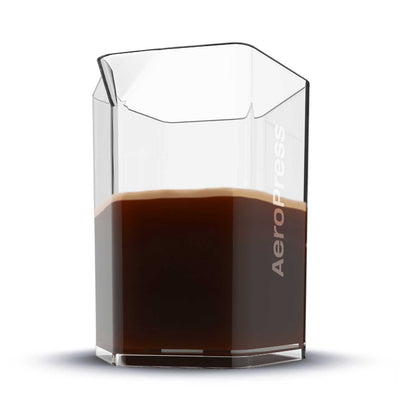


Borosilicate Espresso Shot Glass with Scale Markings
$14.90 $38.00
Stop guessing your espresso yield with this precision shot glass featuring clear mL and oz scale markings for consistent shot ratios every time.
Explore ProductBeyond Volume: Integrating Weight for Complete Precision
While volume markings provide immediate visual feedback, they do not tell the complete story. Espresso density varies with roast level and extraction percentage. A 2-ounce yield from a dark roast weighs significantly more than the same volume from a light roast due to dissolved solids and oil content. To achieve absolute precision, you must measure both volume and mass.
The ideal workflow involves placing your measuring shot glass for espresso on a precision scale, taring to zero, then brewing directly into the vessel. This simultaneous measurement provides both milliliter readings and gram weights, revealing the correlation between visual cues and actual mass. When your Black Warrior M2 Espresso Scale with Flow Detect shows your target gram weight while your marked glass shows corresponding volume, you know your extraction parameters are perfectly dialed.
Precise Measurement Tools for Perfect Extraction

Black Warrior M2 Espresso Scale with Flow Detect
$57.90
$97.00
Take your precision brewing to the next level with this 0.1g accuracy scale featuring automatic flow detection and intelligent espresso mode. Learn more ➔

Walnut Wood Precision Coffee Scale 0.1g Accuracy
$39.90
$93.00
Combine elegant walnut wood aesthetics with laboratory-grade 0.1g precision for a coffee scale that looks as good as it performs. Learn more ➔
Understanding the Numbers: Dose to Yield Ratios
Standard brewing ratios provide starting points for calibration:
- Ristretto: 1:1 to 1:1.5 ratio (thick, intense, low volume)
- Normale (Standard): 1:2 ratio (balanced, traditional espresso)
- Lungo: 1:3 to 1:4 ratio (lighter body, higher volume)
For a standard double shot using 18 grams of coffee, you target 36 grams of espresso output. However, because crema adds aerated volume, your espresso cup with measurements might show 45-50 milliliters when the scale reads 36 grams. Understanding this discrepancy helps you identify when shots are over or under-extracted based on both visual and numerical data.

Mastering Technique: Reading the Meniscus
Accurate volume measurement requires proper technique. When espresso fills your shot cup with scale, the liquid surface forms a meniscus, a slight curve caused by surface tension. To read accurately, position your eye level with the marking line and observe the bottom of the curve for precise measurement. Reading from above or below introduces parallax error, potentially throwing off your ratio by several milliliters.
Temperature also affects accuracy. Hot espresso temporarily expands the glass and continues dripping slightly after you stop the pump. For absolute precision, start your timer when the first drop hits the glass and stop extraction when you reach your target volume minus 2-3 milliliters, allowing for the tailing droplets. Pre-warming your Borosilicate Espresso Shot Glass with Scale Markings prevents thermal shock and temperature differentials that might affect the reading.
Pro Tip: Marked glasses work best when combined with a precision scale. While the espresso cup with scale markings shows immediate volume feedback, the Walnut Wood Precision Coffee Scale 0.1g ensures your input dose matches your output mass, accounting for density variations between different roasts and origins.
Conclusion: Precision is a Practice, Not an Accident
Consistency separates amateur espresso from café-quality results. By incorporating an espresso cup with measurements into your workflow, you transform subjective visual assessment into objective data collection. Clear milliliter and ounce demarcations eliminate the ambiguity of crema-based estimation, while durable borosilicate construction ensures longevity through daily thermal cycling.
Remember that precision tools amplify good technique rather than replacing it. When you pair a measuring shot glass for espresso with a precision scale, you create a feedback loop that connects grind size, dose, yield, and taste. This systematic approach allows you to replicate perfect extractions consistently, debug sour or bitter shots effectively, and ultimately develop the intuition that defines master baristas. Your espresso ritual deserves measurement tools that match your commitment to quality.
Frequently Asked Questions about Espresso Cup Measurements
To measure espresso cup size accurately, you need to distinguish between total capacity and brewed yield. Use a graduated espresso cup or shot glass with clearly marked milliliter and ounce indicators. Fill the vessel with water to the brim to determine total capacity, or brew directly into it to measure your actual espresso yield. For consistent results, place the measuring cup on a precision scale and tare it to zero before brewing. This dual approach ensures you are hitting your target ratios every time.
No, 2 ounces of espresso typically equals one double shot, not two separate shots. A standard single shot (solo) yields approximately 1 ounce (30ml), while a double shot (doppio) produces roughly 2 ounces (60ml). When you see demarcations on an espresso shot glass with scale at 1oz and 2oz lines, these correspond to single and double shot targets respectively. Some modern specialty cafes use different ratios, but the classic Italian standard defines 25-30ml for a single and 50-60ml for a double.
In the United States, one cup equals 240 milliliters (8 fluid ounces), while in many Commonwealth countries and metric-standard regions, a cup is defined as 250 milliliters. However, when brewing espresso, cup measurements matter less than precise shot volumes. Espresso extraction relies on standardized shot glasses marked in milliliters, where accuracy to the milliliter impacts your brew ratio. Rather than converting between cup standards, use an espresso cup with measurements marked clearly in both milliliters and ounces to eliminate confusion.
For a standard single shot of espresso (approximately 1 ounce or 30ml yield), use 7 to 9 grams of finely ground coffee. For a double shot (2 ounces or 60ml yield), use 18 to 20 grams of coffee. This creates the classic 1:2 to 1:3 brew ratio (coffee-in to espresso-out) that defines traditional espresso. Using a measuring shot glass for espresso helps you verify that your output matches your input, while a precision scale ensures your dose is exact. Adjust these parameters based on your taste preferences and bean characteristics.


