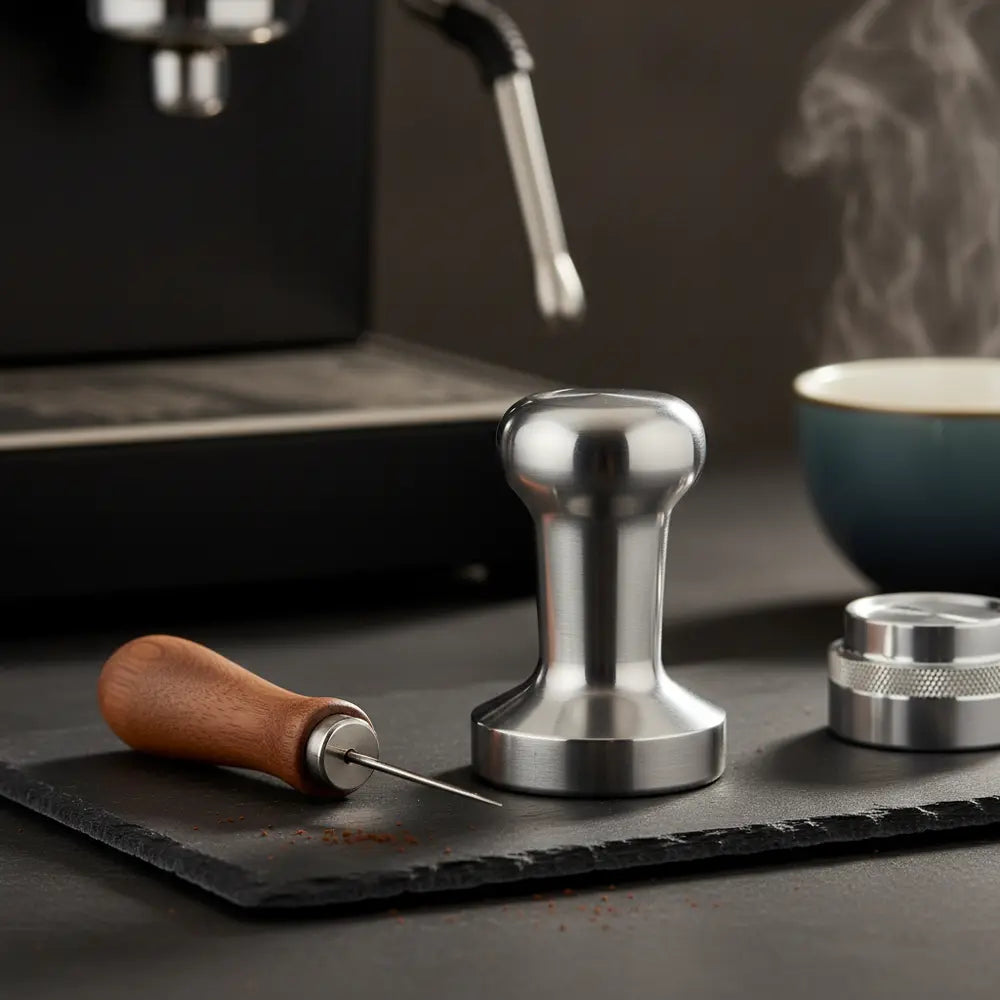
Precision starts before the first drop hits your cup. Every espresso shot you pull is shaped by the tools you use during puck preparation, dosing, and distribution — and the right barista tool transforms inconsistent mornings into repeatable excellence. At Rethink Cafe, we curate espresso accessories and coffee tools built for one purpose: helping you extract more flavor with less guesswork.
Whether you're assembling your first barista kit or upgrading individual pieces of your workflow, this collection brings together the tampers, distribution tools, WDT needles, scales, and accessories that serious home baristas and professionals rely on daily.
Why the Right Barista Tools Change Everything
Espresso is unforgiving. A few grams off on your dose, an uneven tamp, or a single channel through your puck can turn specialty beans into a bitter, under-extracted mess. The difference between a good shot and a great one rarely comes down to the machine — it comes down to espresso puck prep.
Quality barista accessories give you control over variables that your espresso machine simply cannot correct on its own. A well-machined coffee tamper ensures a level, consistent bed. A precision leveler removes high spots before tamping. A WDT tool breaks up clumps that would otherwise create fast-flow channels.
These aren't luxury upgrades. They're the foundation of consistent extraction, and they're exactly what separates a frustrating learning curve from a rewarding daily ritual.
Essential Barista Accessories for Espresso Prep
Building a reliable espresso workflow means understanding which tools address which variables. Here's how each core category of barista accessories fits into the process, from bean to shot.
Dosing and Weighing
Consistency begins with knowing exactly how much coffee enters your portafilter. A digital scale for espresso with 0.1-gram resolution removes the guesswork that comes with volumetric dosing. Paired with a coffee dosing funnel, you eliminate grounds scattered across your counter and ensure every milligram ends up in the basket where it belongs.
Weighing your dose is the single easiest improvement most home baristas can make. It costs seconds and saves entire shots.
Distribution and WDT Tools
Once grounds land in the basket, they rarely settle evenly. Clumps form during grinding, static causes uneven distribution, and the result is channeling — water finding the path of least resistance instead of flowing uniformly through the entire puck.
A WDT tool (Weiss Distribution Technique) uses fine needles to break apart clumps and redistribute grounds before leveling. This simple step is one of the most effective ways to eliminate channeling and achieve even extraction across the entire basket.
After WDT, a distribution tool or precision leveler smooths the surface into a flat, uniform bed. The combination of needle distribution followed by leveling creates the kind of puck consistency that produces balanced, sweet espresso with minimal astringency.
Tampers and Tamper Mats
The barista tamper is probably the most iconic espresso accessory, and for good reason. A flat, even tamp at consistent pressure seals the puck preparation process and sets the stage for uniform water flow during extraction.
Not all tampers are created equal. Cheap, lightweight tampers make it difficult to apply even pressure, and poorly machined bases leave gaps around the basket edge. A well-fitted tamper — one that matches your portafilter diameter precisely — eliminates side channeling and gives you a tactile sense of puck resistance that becomes second nature over time.
A tamper mat protects your countertop and provides a stable, non-slip surface for tamping. It's a small addition that makes a noticeable difference in workflow comfort, especially when you're pulling multiple shots in a row.
Bottomless Portafilters
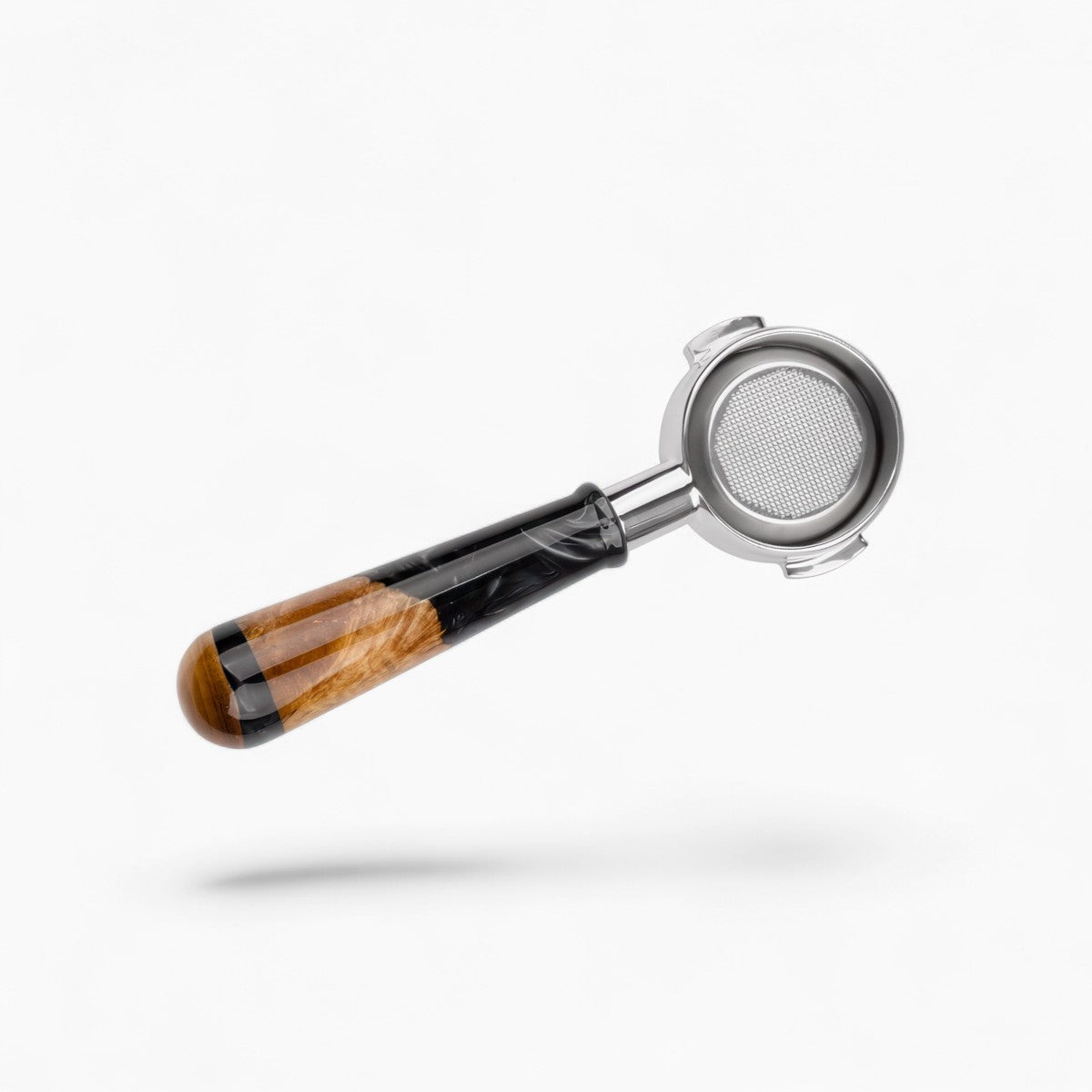
If you're serious about diagnosing and improving your puck prep, a bottomless portafilter is indispensable. By removing the spouts, you can see exactly how water flows through the coffee bed in real time.
Channeling, uneven flow, and blonding become immediately visible. It's the most honest feedback tool in espresso — and the fastest way to learn what your tamping, distribution, and dosing adjustments actually do to extraction quality.
Building a Complete Barista Tool Kit
Buying individual tools one at a time works, but a thoughtfully assembled barista tool kit gets you to consistent results faster. The best kits combine the essentials — tamper, distribution tool, WDT needle, dosing funnel, and often a barista scale — into a coordinated set designed to work together.
For someone just starting their espresso journey, a complete kit removes the paralysis of choosing between dozens of individual products. For experienced baristas, upgrading to a matched kit often reveals how mismatched components in their current setup were limiting shot quality.
What to Look for in a Barista Kit
The best barista kit options prioritize compatibility, materials, and logical workflow coverage. Here's what matters most when evaluating a set.
Diameter matching is critical. Your tamper and distribution tool must fit your basket precisely — typically 51mm, 53mm, 54mm, or 58mm depending on your machine. A tool that's even half a millimeter too small creates an untamped ring around the puck edge where water channels freely.
Material quality determines both longevity and feel. Stainless steel bases, aluminum alloy bodies, and calibrated spring mechanisms all contribute to tools that perform consistently over thousands of uses rather than degrading after a few months.
Finally, consider what the kit actually includes versus what you already own. Some sets focus purely on puck prep tools, while others include accessories like cleaning brushes for baristas, knock boxes, and milk frothing tools that round out the full espresso workflow.
Barista Tools for Specific Espresso Machines
One of the most common frustrations in the espresso accessory world is buying a beautiful tool only to discover it doesn't fit your machine. Portafilter basket diameters vary by manufacturer and model, and even within a single brand's lineup, sizes can differ between entry-level and prosumer machines.
Compatibility with Popular Machines
If you're searching for a Breville barista tool kit or accessories matched to a Breville (Sage) machine, pay special attention to basket diameter. Breville's Barista Express and Barista Pro use 54mm baskets, while many other popular machines from brands like Gaggia, Rancilio, and La Marzocco use the more common 58mm standard.
The Breville Bambino uses a 54mm basket as well, while the Breville Dual Boiler steps up to 58mm. Knowing your exact size before purchasing prevents the disappointment of receiving tools that wobble in the basket or don't seat properly.
Most of the coffee barista accessories in our collection are clearly labeled by compatible diameter. When in doubt, measure the inner diameter of your portafilter basket — not the portafilter itself — and match accordingly.
Do Brand-Specific Accessories Matter?
Machine manufacturers often sell their own branded accessories, and some are genuinely well-made. However, brand-specific doesn't automatically mean better. In many cases, third-party barista tools offer superior materials, tighter machining tolerances, and more thoughtful ergonomic design than what ships with your machine.
The key is compatibility, not brand loyalty. A precision-machined 54mm tamper from a dedicated accessory maker will outperform a stock Breville tamper every time — as long as the diameter matches.
Beyond Puck Prep — Completing Your Espresso Workflow
While puck preparation tools form the core of any barista tool collection, a complete espresso workflow extends beyond the portafilter. The accessories that surround your shot-pulling routine contribute to cleanliness, speed, and overall enjoyment.
Knock Boxes and Cleaning Tools
A knock box keeps your workspace clean between shots and protects your portafilter from the damage that comes with banging it against a trash can or countertop edge. Look for rubber-bar designs with sturdy bases that won't slide during use.
Cleaning brushes for baristas handle the fine grounds that accumulate on your shower screen, group head, and grinder chute. Regular cleaning with proper brushes prevents stale oils from tainting fresh shots — an overlooked detail that impacts flavor more than most people realize.
Milk Frothing and Latte Art
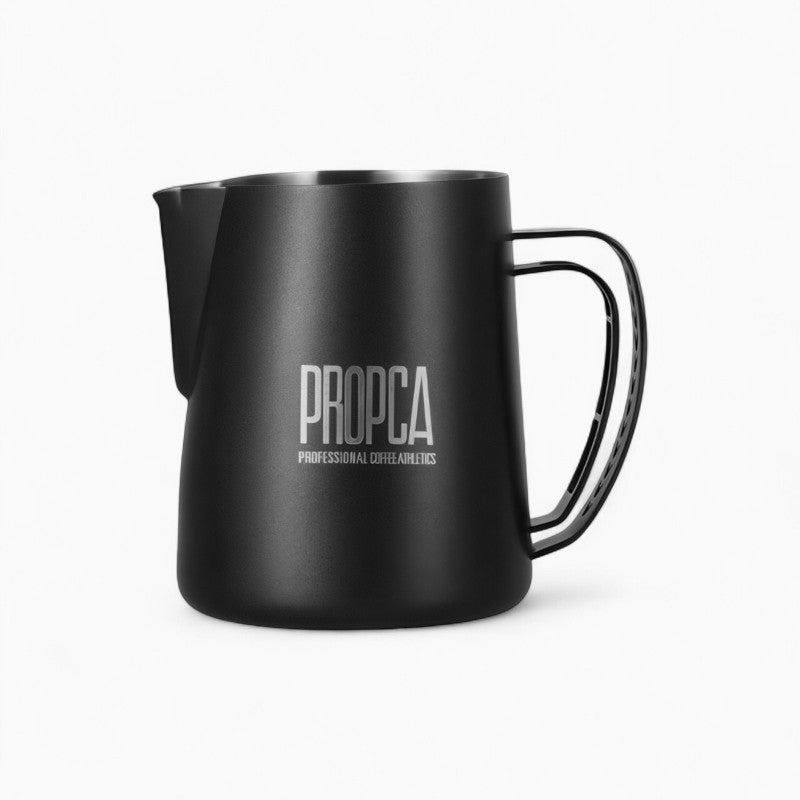
For those who enjoy milk-based drinks, milk frothing tools and a quality latte art kit open up an entirely different dimension of the craft. Precision frothing pitchers with tapered spouts give you the control needed for rosettas, tulips, and hearts.
Steaming technique matters as much as the pitcher design, but starting with a properly shaped jug makes learning dramatically easier. The right pitcher becomes an extension of your hand, translating wrist movements directly into milk patterns on the surface of your espresso.
Build Quality and Materials That Last
Espresso accessories take daily punishment. They get wet, they get covered in coffee oils, they get dropped, and they get used hundreds of times between cleanings. The materials your tools are made from determine whether they'll perform consistently over years or degrade within months.
Stainless steel remains the gold standard for tamper bases, WDT needles, and distribution tool blades. It resists corrosion, maintains dimensional accuracy, and cleans easily. For handles and bodies, anodized aluminum provides an excellent balance of light weight and durability.
Avoid tools with plastic components in high-stress areas. A plastic tamper handle might feel acceptable during your first week, but the flex it introduces under pressure compromises the level tamp you're trying to achieve. Similarly, rubber-coated distribution tool fins tend to collect coffee oils and become sticky over time.
Every barista tool in our collection is selected with these material standards in mind. We stock what we'd use on our own bar — nothing more, nothing less.
Portable Barista Kits for Travel
The rise of compact, travel-friendly espresso makers like the Flair, Cafelat Robot, and portable lever machines has created genuine demand for portable barista tool kits that perform at home-bar standards while fitting in a bag.
A travel-ready barista kit typically prioritizes compact sizing, protective cases, and multi-function tools that reduce the total number of pieces you need to carry. Some kits combine a tamper and distribution tool into a single dual-ended unit, saving space without sacrificing function.
If you travel frequently and refuse to drink hotel coffee, a portable kit isn't a luxury — it's the difference between bringing your craft with you and leaving it behind.
Achieving Consistent Extraction Every Morning
The ultimate goal of every barista tool in this collection is the same: repeatable, delicious espresso. Not one lucky shot followed by three mediocre ones, but consistent quality that you can rely on every single morning.
That consistency comes from controlling variables. Weigh your dose with a precise scale. Distribute evenly with a WDT tool. Level with a calibrated distribution tool. Tamp flat and firm. These steps take under thirty seconds once they become habit, and they transform your relationship with espresso from a gamble into a craft.
At Rethink Cafe, we believe that better tools don't just make better coffee — they make the process itself more satisfying. When your workflow feels dialed, when each step clicks into the next with purpose, the ritual becomes as rewarding as the result in your cup.
Frequently Asked Questions About Barista Tools
A barista uses a range of tools depending on whether they're preparing espresso, steaming milk, or maintaining equipment. Core espresso prep tools include a tamper, distribution tool, WDT needle, dosing funnel, and digital scale. For milk drinks, a frothing pitcher and thermometer are standard.
Supporting accessories like a knock box, cleaning brushes, tamper mat, and bottomless portafilter round out a professional or serious home setup. Each tool addresses a specific variable in the brewing process.
A typical barista tool kit includes a tamper, a distribution or leveling tool, a WDT tool, and a dosing funnel — all matched to a specific portafilter diameter. More comprehensive kits may also include a precision scale, tamper mat, cleaning brush, and a carrying case for portability.
The exact contents vary by brand and price point, but the best kits cover the full puck preparation workflow so you can achieve consistent extraction right out of the box.
Barista tools go by many specific names depending on their function. The most common include tampers (for compressing grounds), distribution tools or levelers (for evening the coffee bed), WDT tools (for declumping), dosing funnels, knock boxes, and barista scales.
Collectively, they're often referred to as barista accessories, espresso accessories, or coffee tools. A bundled set is typically called a barista kit or barista tool kit.
A coffee needle tool is called a WDT tool, which stands for Weiss Distribution Technique. It uses thin needles — typically between 0.3mm and 0.4mm — to stir and break apart clumps in the coffee grounds before tamping.
WDT is widely regarded as one of the most effective single upgrades for improving espresso extraction evenness and eliminating channeling.
The most important factor is portafilter basket diameter. Measure the inner diameter of your basket — not the portafilter body — and match your tamper and distribution tool to that size. Common sizes are 51mm, 53mm, 54mm (Breville/Sage), and 58mm (most prosumer and commercial machines).
Beyond diameter, consider your workflow needs. If your machine lacks a built-in scale, a barista scale is essential. If you're using a pressurized basket, upgrading to a non-pressurized basket alongside proper puck prep tools will yield the biggest improvement.
Look for stainless steel on tamper bases, WDT needles, and any surface that contacts coffee or water. Stainless steel resists corrosion, holds dimensional accuracy, and is easy to clean. Anodized aluminum is excellent for handles and tool bodies — it's lightweight, durable, and resistant to wear.
Avoid tools with plastic in structural or high-pressure areas. Plastic flexes under tamping pressure and degrades faster when exposed to coffee oils and repeated cleaning.
If you travel with a portable espresso maker like a Flair, Cafelat Robot, or AeroPress-to-espresso setup, a portable barista kit is absolutely worth it. Without proper puck prep tools, even the best portable brewer will produce inconsistent results.
Travel kits are designed to be compact and often include multi-function tools — such as a combined tamper and leveler — that save space. A protective case keeps everything organized and prevents damage in transit.
In most cases, no. What matters is dimensional compatibility — particularly the basket diameter — rather than brand matching. Third-party barista tools often surpass OEM accessories in material quality, machining precision, and ergonomic design.
That said, a few machine-specific components like proprietary portafilter handles or specialized shower screens may require brand-specific parts. For puck prep tools like tampers, distributors, and WDT tools, focus on fit and build quality over brand name.
Baristas create designs — known as latte art — on the surface of milk-based espresso drinks like lattes, cappuccinos, and flat whites. The "canvas" is the layer of crema on the espresso, and the "paint" is carefully steamed and textured microfoam milk.
Classic patterns include rosettas, tulips, and hearts. Baristas use precision frothing pitchers with tapered spouts to control milk flow, and some use etching tools or latte art pens for more detailed designs.